Search used to mean one thing: typing a few keywords into Google and scrolling through blue links. In 2026, that’s no longer the full picture. People now split their searches across Google, ChatGPT, Claude, and Gemini — and each platform is trained to interpret intent differently, which means the same question can produce four very different kinds of answers. For marketers, understanding these behavioral shifts is no longer optional; it’s the foundation of visibility, which is exactly why this topic has become a core module in leading Digital marketing courses pune programs preparing students for AI-driven search.
Quick context: A growing share of information-seeking now happens outside traditional search engines entirely, with conversational AI tools becoming a first stop for research, comparisons, and recommendations.
Why Search Behavior Is Fragmenting
For nearly 20 years, “search” meant one interface and one mental model — type keywords, scan a results page, click a link. AI chat tools broke that pattern. Instead of returning a list of options, they hold a conversation, ask clarifying questions, and synthesize an answer directly. As users get comfortable with this format, they naturally start choosing different tools for different needs — a quick fact still goes to Google, but a nuanced comparison or a creative task increasingly goes to an AI assistant instead.
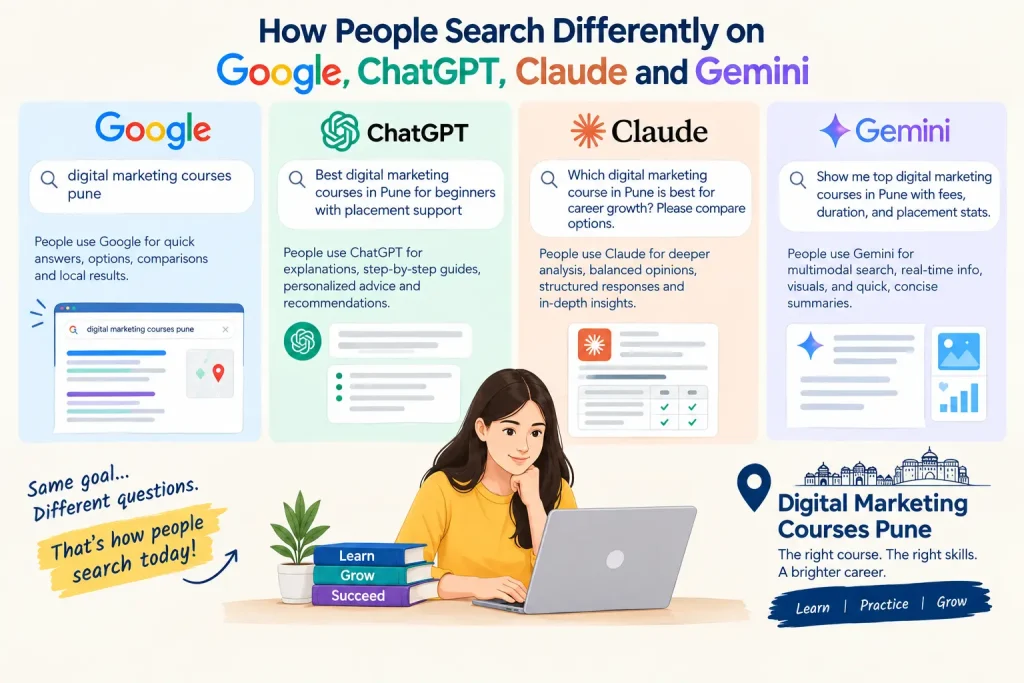
How People Actually Search on Each Platform
Short, keyword-style queries aimed at quick facts, local results, prices, or navigation to a known site. Users skim multiple results and compare before clicking.
ChatGPT
Long, conversational questions — often multi-step — for brainstorming, drafting, comparisons, or step-by-step explanations. Users refine the answer through follow-up questions.
Claude
Detailed, nuanced prompts for analysis, writing, and reasoning-heavy tasks, where users expect careful, well-structured, thoughtful answers over quick snippets.
Gemini
A blend of both worlds — quick factual queries plus conversational ones, often tied closely into everyday Google services, docs, and search results.
Search Behavior Shift: The Numbers
Query Length
2–3x Longer
Typical prompt length on AI chat tools compared to a traditional Google search query.
Follow-Up Rate
High
Most AI chat sessions involve multiple follow-up questions rather than a single search-and-click.
Zero-Click Growth
Rising Fast
A growing share of searches now end without a single website click as AI answers satisfy the intent directly.
Platform Comparison at a Glance
| Platform | Typical Query Style | Best Suited For |
|---|---|---|
| Short keywords | Quick facts, local search, navigation | |
| ChatGPT | Conversational, multi-step | Brainstorming, drafting, comparisons |
| Claude | Detailed, reasoning-based | In-depth analysis and structured writing |
| Gemini | Mixed short and conversational | Everyday queries tied to Google ecosystem tools |
Why This Matters for Businesses and Marketers
If your content is only optimized for short-keyword Google searches, you may already be invisible to a growing segment of users researching through AI chat tools. These platforms don’t rank pages the way search engines do — they extract, summarize, and cite information based on clarity, structure, and trustworthiness. That means content built purely around keyword density no longer guarantees visibility across the full search landscape.
How to Optimize Content for Multi-Platform Search
Write in a direct, answer-first format — lead with the answer, then explain, so both search engines and AI models can extract it easily.
Structure content with clear headings and lists — this format is easier for AI systems to parse and summarize accurately.
Add schema markup — structured data helps both search engines and AI crawlers understand your content and business accurately.
Build genuine topical authority — cover a subject thoroughly across multiple pages instead of thin, one-off posts.
Earn credible mentions and citations — being referenced by trusted sources increases your chances of being surfaced by AI tools.
Challenges Brands Face in This New Search Reality
Adapting to multi-platform search isn’t automatic, and several challenges commonly trip up brands making the shift.
Reduced Click-Through Visibility
As AI tools answer questions directly, fewer users click through to the original source, making traditional traffic metrics harder to rely on alone.
Inconsistent Measurement Tools
Tracking how often your content is referenced inside AI-generated answers is still an evolving discipline compared to mature SEO analytics.
Balancing Multiple Optimization Styles
Writing for short-keyword search and long-form conversational AI at the same time requires a more flexible content strategy than traditional SEO alone.
How to Choose the Right Best gym near me
If you want to learn how to optimize content across Google, ChatGPT, Claude, and Gemini alike, choosing the right local training institute matters. Look for a program that teaches structured content writing, schema markup, and AI search optimization alongside traditional SEO fundamentals. Below is the location map to help you find the right training center near you.
Ready to make your content visible across every search platform?
📞 Call Now: 08007777243Frequently Asked Questions
Is Google search becoming less relevant because of AI chat tools?
Not entirely — Google is still dominant for quick facts and local search, but AI tools are increasingly capturing research-heavy and comparison-based queries.
Do ChatGPT, Claude, and Gemini rank content the same way as Google?
No, these tools don’t use traditional page ranking; instead they extract and synthesize information based on clarity, structure, and perceived trustworthiness.
Should businesses optimize separately for each AI platform?
A single well-structured, clear content strategy generally works across platforms, though understanding each tool’s query style helps refine that strategy further.
What is “zero-click search” and why does it matter?
Zero-click search happens when a user’s question is fully answered without clicking a website, making brand visibility inside the answer itself increasingly important.
Where can I learn how search behavior across AI platforms is changing?
A structured digital marketing course covering SEO, schema markup, and AI search optimization is the most practical way to understand and adapt to these shifts.
Final Takeaway: Search is no longer a single destination — it’s a fragmented experience across Google, ChatGPT, Claude, and Gemini, each shaped by different user expectations and query styles. Brands that understand and adapt to these differences will maintain visibility no matter where their audience chooses to search. To build these forward-looking skills, explore trusted Digital marketing courses in Pune and stay ahead as search continues to evolve.