Artificial intelligence is changing how marketers research, create, advertise, analyse data and communicate with customers. Tasks that once took hours can now be completed faster with the right AI-assisted workflow. But this does not mean digital marketers are becoming unnecessary — it means the role is changing.
For students exploring Digital Marketing Courses in Pimpri-Chinchwad, this shift creates a new question: what should you actually learn when AI can already generate content, suggest keywords, create ad variations and summarise data? The answer is not to learn AI alone. You need strong marketing fundamentals combined with the ability to use AI intelligently.
The most valuable marketers will be people who can understand customers, make strategic decisions, evaluate AI output, work with data and turn technology into measurable business results.
How Is AI Changing Digital Marketing Careers?
AI is moving digital marketing from repetitive execution toward faster research, analysis, experimentation and decision-making. A marketer can use AI to support tasks such as:
- Keyword clustering and search-intent analysis
- Content research and topic ideation
- Ad-copy variations
- Social media content ideas
- Competitor research
- Customer segmentation
- Reporting and data interpretation
- Creative development
- Workflow automation
- Campaign analysis
Google itself is adding AI-powered capabilities across advertising and analytics, showing that AI is becoming part of everyday marketing workflows rather than remaining a separate technology.
Will AI Replace Digital Marketing Jobs?
AI is more likely to change digital marketing roles than simply eliminate them. A marketer who spends most of their time doing repetitive tasks may see parts of that work automated. At the same time, businesses still need people who understand customers, positioning, creative strategy, campaign objectives, brand voice, data and business goals.
The World Economic Forum reports that AI and other technologies are increasing demand for technical skills while human abilities such as creative thinking, analytical thinking, flexibility and collaboration remain important.
That combination is far more valuable than simply knowing how to use a chatbot.
Which Digital Marketing Skills Matter Most in the AI Era?
1. Marketing Strategy
Tools change quickly, but marketing fundamentals remain useful. You should understand target audiences, customer journeys, marketing funnels, positioning, lead generation, conversion goals, customer intent and campaign objectives. If you do not understand the business problem, an AI tool can produce a lot of content without producing useful marketing.
2. SEO and Search Understanding
SEO is also evolving because people are increasingly using AI-powered search experiences. Marketers now need to understand search intent, keyword research, topic clusters, on-page and technical SEO, internal linking, local SEO, helpful content, entity relationships and AI search visibility. Google’s guidance makes it clear that existing SEO fundamentals remain relevant for AI features such as AI Overviews and AI Mode.
3. Data and Analytics
AI can identify patterns quickly, but someone still needs to understand what those patterns mean. A modern digital marketer should be comfortable with Google Analytics 4, Google Search Console, conversion tracking, traffic sources, engagement metrics, campaign performance and basic reporting. The better question is never just “traffic increased” — it’s why it increased, which channel contributed, and whether that activity supported the business objective.
4. Content and Creative Thinking
AI can generate drafts, but generic content is easy to produce. Human creativity becomes more valuable when marketers need to create strong campaign concepts, brand stories, original angles, social media ideas, video concepts and customer-focused content. Google’s own guidance for AI search continues to emphasise helpful, reliable and original content over mass-produced material without added value.
5. Communication and Decision-Making
A marketer may have excellent tools but still struggle to explain a campaign to a client or team. Communication helps you present campaign ideas, explain performance, write clear reports, understand client requirements, defend strategic decisions and collaborate with designers and developers. These skills are difficult to automate because they depend heavily on context and judgement.
What AI Tools Should a Digital Marketing Student Learn?
You do not need to collect dozens of AI subscriptions. Instead, learn how AI can support different parts of a marketing workflow.
| Marketing Area | AI-Assisted Use |
|---|---|
| SEO | Research, clustering, content ideas |
| Content | Outlines, drafts, variations |
| Google Ads | Creative and campaign support |
| Social Media | Ideas, captions, content planning |
| Analytics | Summaries, pattern identification |
| Email Marketing | Subject lines and content variations |
| Research | Competitor and audience insights |
| Reporting | Data summaries and presentation support |
The real skill is knowing what to ask, checking the response and applying marketing judgement. A generated answer should never automatically become your final answer.
SEO, GEO and the New Search Experience
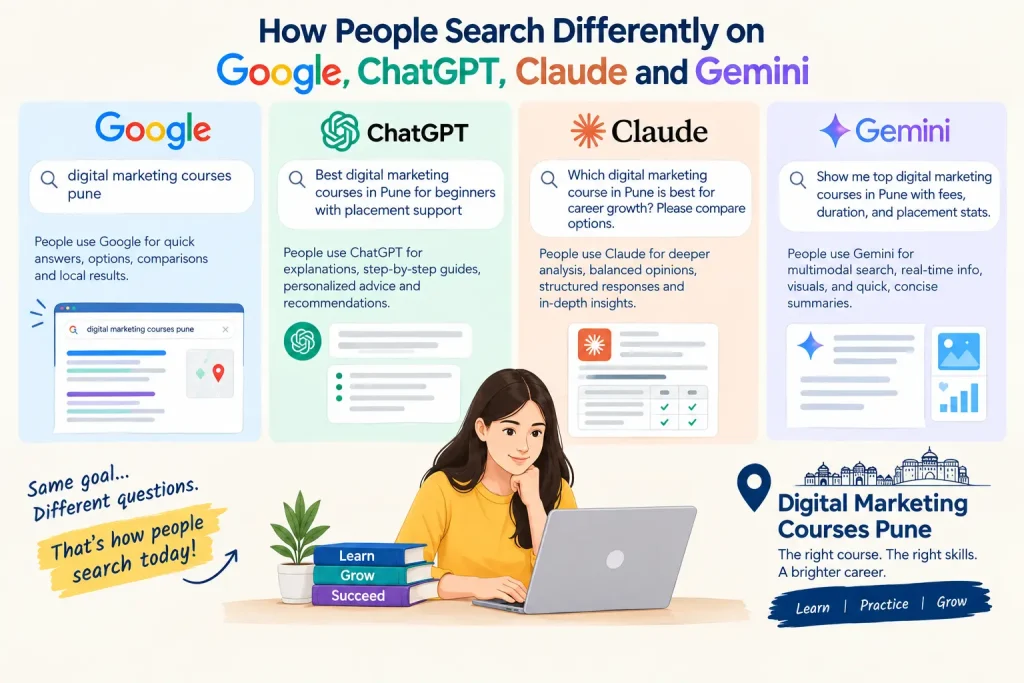
Search is becoming more conversational. People may still search Google with keywords, but they are also asking longer questions and using AI-powered experiences to compare options, understand topics and discover websites. This has created growing interest in Generative Engine Optimization (GEO).
GEO focuses on making information useful and understandable for AI-driven discovery. However, it should not be treated as a replacement for SEO. Google’s current documentation says there are no special technical requirements specifically for appearing in AI Overviews or AI Mode — strong technical SEO, indexed content and helpful, people-first information remain foundational.
For future digital marketers, this means understanding both search visibility and AI-driven discovery together — an important skill area for anyone entering modern SEO and content marketing.
How AI Is Changing Different Digital Marketing Roles
AI affects almost every marketing specialisation, but the human role remains important.
SEO Executive
AI can help with research, clustering and content ideas. The SEO professional still needs to evaluate search intent, competition, technical issues and content quality.
Performance Marketer
AI can support campaign analysis, creative variations and optimisation. The marketer remains responsible for budgets, objectives, targeting and business results.
Content Marketer
AI can speed up research and drafting. The content marketer adds originality, brand understanding, fact-checking and editorial judgement.
Social Media Marketer
AI can help generate ideas and variations, but understanding trends, communities, audiences and brand personality still requires human input.
Digital Marketing Analyst
AI can help summarise large amounts of information, while the analyst turns data into decisions and recommendations.
How TIP Fits Into the Journey
Before joining any course, you do not need an advanced technical background to start. Look for training that combines digital marketing fundamentals, SEO and search intent, paid advertising, social media, content marketing, analytics and reporting, website basics, AI-assisted marketing workflows, practical assignments and strategy-led decision-making.
TIP’s existing training information highlights practical learning, live projects, AI-powered marketing tools, Google Ads and Meta Ads training, internship support and placement assistance. It also states that TIP has been providing training since 2011. These points can be useful when evaluating a training provider, but students should still attend a demo and understand exactly what practical work they will perform.
Why Human Skills Matter More Alongside AI
The more accessible AI becomes, the less valuable basic tool access alone becomes. What differentiates a marketer is the ability to ask better questions, think critically, understand people, recognise weak information, make decisions, communicate clearly, solve problems, create original ideas and connect marketing activity to business outcomes.
This combination of technology and human capability is reflected in broader workforce research, which identifies AI and technological literacy alongside creative thinking, analytical thinking and adaptability as increasingly important skills.
A Simple Roadmap to Become an AI-Ready Digital Marketer
- Learn marketing fundamentals — understand audiences, funnels, positioning and objectives.
- Learn the core channels — build a foundation in SEO, paid advertising, social media and content.
- Learn analytics — understand how to measure traffic, engagement and conversions.
- Add AI to your workflow — use AI for research, ideation, analysis and repetitive tasks.
- Practise decision-making — do not accept AI recommendations blindly; check them against data and business goals.
- Build practical experience — work on campaigns, content plans, SEO tasks and reports.
- Keep adapting — platforms, search experiences and marketing tools will continue to change.
Key Takeaways
- AI is changing digital marketing workflows, not making marketing knowledge irrelevant.
- Marketing strategy, SEO, analytics and customer understanding remain essential.
- AI can support research, content, advertising, reporting and automation.
- GEO and AI search are becoming relevant alongside traditional SEO.
- Human creativity, critical thinking and communication remain valuable.
- Students should learn how to evaluate AI output rather than blindly accept it.
- Practical training is more useful when AI is connected to real marketing objectives.
When comparing Digital Marketing Courses in Pimple Saudagar or Pimpri-Chinchwad, look for practical AI-assisted workflows along with strong marketing fundamentals.
Frequently Asked Questions
How is AI changing digital marketing careers?
AI is automating repetitive tasks and helping marketers research, create, analyse and optimise faster. Human strategy, creativity and judgement remain essential.
Will AI replace digital marketers?
AI is more likely to change digital marketing roles than remove the need for marketers. Professionals who combine marketing knowledge with AI skills can remain valuable.
What AI skills should a digital marketer learn?
Learn AI-assisted research, content ideation, keyword clustering, data analysis, campaign support, automation and prompt-based workflows while developing strong marketing fundamentals.
Is SEO still important with AI search?
Yes. Google states that SEO fundamentals remain relevant for AI-powered search experiences, including AI Overviews and AI Mode.
What is GEO in digital marketing?
Generative Engine Optimization, or GEO, refers to improving content and information so it can be discovered and understood in generative AI search experiences.
Can beginners use AI tools for digital marketing?
Yes. Beginners can use AI for research, brainstorming, content planning and reporting, but they should fact-check outputs and learn the marketing concepts behind the work.
Can AI help with Google Ads?
Yes. AI-powered features can assist with advertising workflows, creative development, insights and optimisation. Marketers still need to understand campaign objectives, budgets and performance.
Can AI write SEO content?
AI can help with research, ideas, outlines and drafts. However, useful SEO content still requires originality, accuracy, search-intent understanding and human review.
Don’t Just Learn AI Tools. Learn How to Use Them for Marketing.
Build a strong foundation in digital marketing while learning how AI can support SEO, advertising, content, analytics and everyday marketing tasks.
Join Our Digital Marketing Course