
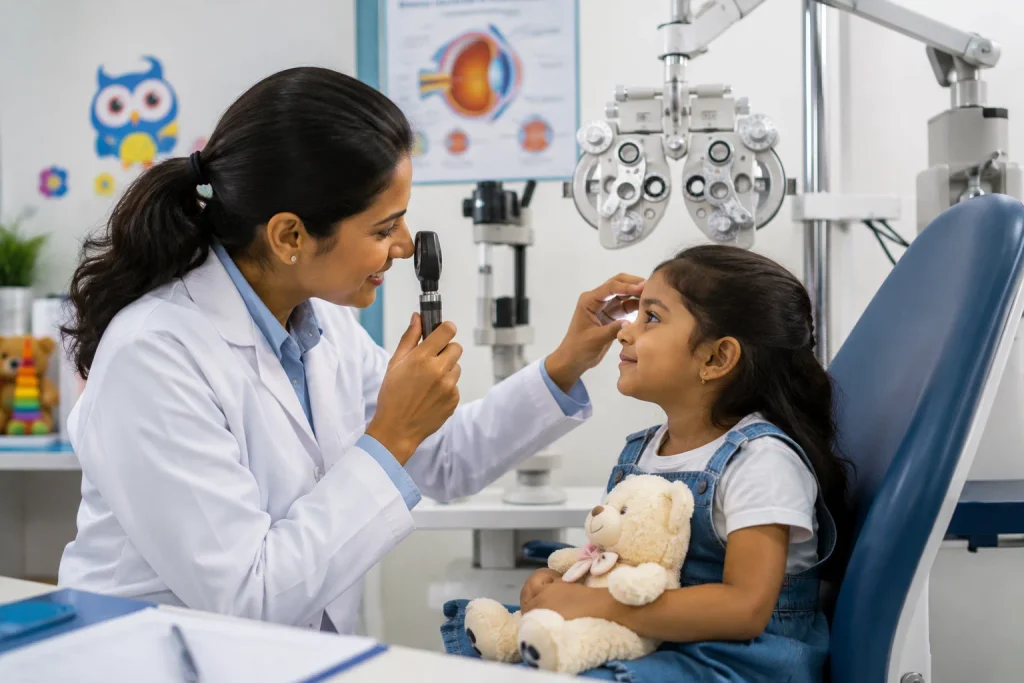
Children rarely complain about poor vision because they assume everyone sees the way they do. A child who squints at the blackboard, sits too close to the TV or avoids reading may simply be struggling to see clearly. Since nearly 80% of learning in the early years happens through the eyes, undetected vision problems can quietly affect school performance, confidence and even physical coordination.
Early detection is the most powerful tool a parent has, and it begins with the right doctor. Consulting an experienced Pediatric Ophthalmologist in Shivaji Nagar ensures that your child’s eyes are examined with child-friendly equipment, patience and the specialised knowledge that growing eyes demand. At Raghav Eye Hospital, we focus on making every visit comfortable, gentle and anxiety-free for both children and parents.
👁 Quick Eye-Health Highlights for Parents
- 1 in 5 school-going children may have an undiagnosed vision problem.
- Lazy eye (amblyopia) is best treated before the age of 8.
- Myopia is rising fast among children who spend long hours on screens.
- First eye check-up is ideal at 6 months, 3 years and before school.
- Painless, child-friendly tests take less time than most parents expect.
Why Children’s Eye Care Cannot Wait
A child’s visual system is still developing until around age eight to ten. During this period, the brain learns to interpret signals from both eyes. If one eye sends a blurry image because of an uncorrected refractive error, squint or other issue, the brain may begin to ignore that eye. This condition, known as amblyopia or lazy eye, can become permanent if not treated in time.
Unlike adults, children cannot describe what they are experiencing. They adapt by tilting their head, closing one eye or avoiding tasks that strain their vision. Because these behaviours are easily mistaken for carelessness or poor concentration, many vision problems go unnoticed for years. Regular screening by a specialist closes this gap and protects your child’s learning journey.
Pediatric eye doctors are trained to examine infants, toddlers and teenagers using age-appropriate methods such as picture charts, preferential looking tests, cycloplegic refraction and gentle dilated eye examinations. These techniques give accurate results even when a child cannot read letters or answer questions.
Common Eye Problems Seen in Children
Children can develop a wide range of eye conditions, from simple refractive errors to complex congenital disorders. The most common ones include:
Myopia (Short-Sightedness)
Distant objects look blurry. It is increasing rapidly due to screen time and less outdoor play.
Amblyopia (Lazy Eye)
Reduced vision in one eye even with glasses, caused by poor visual development in early years.
Squint (Strabismus)
Eyes that do not align properly. It may be constant or occasional and needs timely treatment.
Congenital Cataract
Cloudiness in the lens present from birth that can block vision if left untreated.
Blocked Tear Duct
Watery, sticky eyes in infants, often resolved with massage or a minor procedure.
Allergic Conjunctivitis
Itchy, red, watery eyes triggered by dust, pollen or pollution, common in school-age children.
Warning Signs Your Child Needs an Eye Check-Up
Parents and teachers are often the first to notice that something is wrong. Watch for these signals and book an appointment without delay:
- Frequent squinting, eye rubbing or blinking
- Sitting very close to the television or holding books near the face
- Tilting the head or covering one eye while looking at something
- Complaints of headaches, especially after reading or screen use
- Watery eyes, redness or sensitivity to light
- Eyes that appear misaligned or crossed
- Declining grades, loss of interest in reading or poor hand-eye coordination
- A family history of squint, high power glasses or childhood eye disease
Pediatric Eye Care Services at Raghav Eye Hospital
Raghav Eye Hospital offers complete, family-friendly eye care under one roof. Our team understands that children need a different approach from adults, so we combine modern diagnostics with a warm, playful environment. Here are the key services we provide:
👓 Comprehensive Eye Exams
Complete vision and eye-health evaluation for infants, children and teens.
👓 Spectacles & Contact Lenses
Accurate prescriptions with durable, comfortable and child-safe frames.
🎯 Squint Evaluation & Treatment
Non-surgical management and surgical correction when required.
🧹 Lazy Eye Therapy
Patching, vision therapy and follow-ups to restore balanced vision.
🔬 Myopia Control
Strategies to slow the progression of power in growing children.
💡 Paediatric Cataract Care
Early diagnosis and safe surgery for congenital and developmental cataracts.
💧 Tear Duct & Allergy Care
Relief for watery, sticky, itchy and infected eyes.
🏫 School Eye Screening
Quick vision screening to catch hidden problems before they affect learning.
How Screen Time Is Affecting Children’s Eyes
Online classes, mobile games and tablets have become part of daily life, and children’s eyes are paying the price. Prolonged near work causes digital eye strain, dryness, headaches and faster progression of myopia. Reduced outdoor time makes it worse, since natural daylight plays a protective role in healthy eye growth.
You do not have to ban screens completely. Follow the 20-20-20 rule: after every 20 minutes of screen use, ask your child to look at something 20 feet away for 20 seconds. Keep screens at arm’s length, ensure good lighting, and encourage at least one to two hours of outdoor play every day.
🍃 6 Easy Habits for Healthy Young Eyes
- Serve vitamin A-rich foods such as carrots, spinach, papaya and eggs.
- Limit recreational screen time and take regular breaks.
- Make outdoor play a daily routine.
- Ensure 8 to 10 hours of sleep every night.
- Teach children to wash hands and avoid rubbing their eyes.
- Schedule a yearly eye check-up, even if vision seems normal.
How to Choose the Right Pediatric Eye Hospital in Shivaji Nagar
Choosing where to take your child for eye care is an important decision. Look beyond convenience and consider the experience of the doctors, the quality of diagnostic equipment and how comfortable the staff make your child feel. A hospital that treats children with patience and explains every step clearly will help your child cooperate during examinations and build trust in regular check-ups.
✅ What to Look For
- Doctors with specialised paediatric training and proven experience
- Child-friendly examination methods and calm, welcoming surroundings
- Advanced diagnostic tools for accurate assessment at every age
- Complete services, from glasses to surgery, under one roof
- Transparent communication, clear treatment plans and reasonable costs
- Easy location, convenient timings and dependable follow-up care
Raghav Eye Hospital meets each of these needs with a caring team, modern technology and an easily accessible location in the heart of Pune. Parents can rely on us for honest advice and treatment that always puts the child first.
📍 Looking for the right care? Visit your trusted Pediatric Ophthalmologist in Shivaji Nagar using the map below.
Frequently Asked Questions (FAQs)
At what age should my child have the first eye check-up?
The first comprehensive eye exam is ideally done at around six months, followed by another at three years and again before your child starts school. Early screening helps identify problems like squint, lazy eye and high refractive errors while they are easiest to treat. Raghav Eye Hospital uses gentle, age-appropriate methods that do not require your child to read letters or speak. If your child has a family history of eye problems, the team at Raghav Eye Hospital may recommend earlier and more frequent visits. Regular check-ups give you complete peace of mind about your child’s visual development.
How do I know if my child has a vision problem?
Common signs include squinting, frequent eye rubbing, headaches, sitting too close to screens and tilting the head to see better. Some children also lose interest in reading or struggle to copy from the board. Because children seldom complain, professional testing is the only reliable way to confirm a problem. Raghav Eye Hospital offers detailed child-friendly evaluations that clearly identify the cause of these symptoms. The specialists at Raghav Eye Hospital will explain the findings in simple language and guide you on the next steps.
Is lazy eye treatable, and how early should treatment start?
Yes, lazy eye responds very well to treatment when it is detected early, ideally before the age of eight. Treatment usually includes correcting the refractive error with glasses, patching the stronger eye and vision therapy exercises. Delayed treatment may result in permanent vision loss in the affected eye. Raghav Eye Hospital creates a personalised plan for each child and monitors progress through regular follow-ups. With the right care at Raghav Eye Hospital, most children achieve significant visual improvement.
Does squint always require surgery?
No, many cases of squint can be managed with glasses, prism lenses, patching or eye exercises. Surgery is recommended only when the misalignment persists or does not improve with non-surgical methods. The decision depends on the type of squint, the child’s age and overall eye health. Raghav Eye Hospital carefully evaluates each case before suggesting any procedure. Parents at Raghav Eye Hospital are always given a clear explanation of all available options, benefits and expected outcomes.
Can too much screen time cause weak eyesight in children?
Extended screen use can cause digital eye strain, dryness and headaches, and it is linked to faster progression of myopia. Lack of outdoor activity adds to the risk, so balance is essential. Simple habits like the 20-20-20 rule, proper lighting and limited recreational screen time can reduce strain significantly. Raghav Eye Hospital offers myopia management advice tailored to each child’s lifestyle and eye health. Parents can visit Raghav Eye Hospital for a screening to find out whether screen habits are affecting their child’s vision.
How can I help my child feel comfortable during an eye exam?
Explain in simple words that the doctor will only look at their eyes using lights and pictures, and that nothing will hurt. Bring a favourite toy or snack and schedule the visit when your child is well rested. Raghav Eye Hospital has a warm, friendly environment, and the staff are trained to make children feel relaxed. Most tests are quick, painless and designed like games. At Raghav Eye Hospital, we encourage parents to stay beside their child throughout the examination.
Final Takeaway
Healthy eyesight is the foundation of your child’s learning, play and confidence. Regular check-ups, a balanced lifestyle and prompt treatment can prevent most childhood vision problems from becoming serious. If you notice any warning signs, do not wait for them to go away on their own.
Choosing the Best Pediatric Ophthalmologist in Shivaji Nagar gives your child access to accurate diagnosis and caring treatment, while a trusted Pediatric Eye Specialist in Shivaji Nagar can guide you at every stage of your child’s visual development. Book an appointment with Raghav Eye Hospital today and give your child the gift of clear, healthy vision.