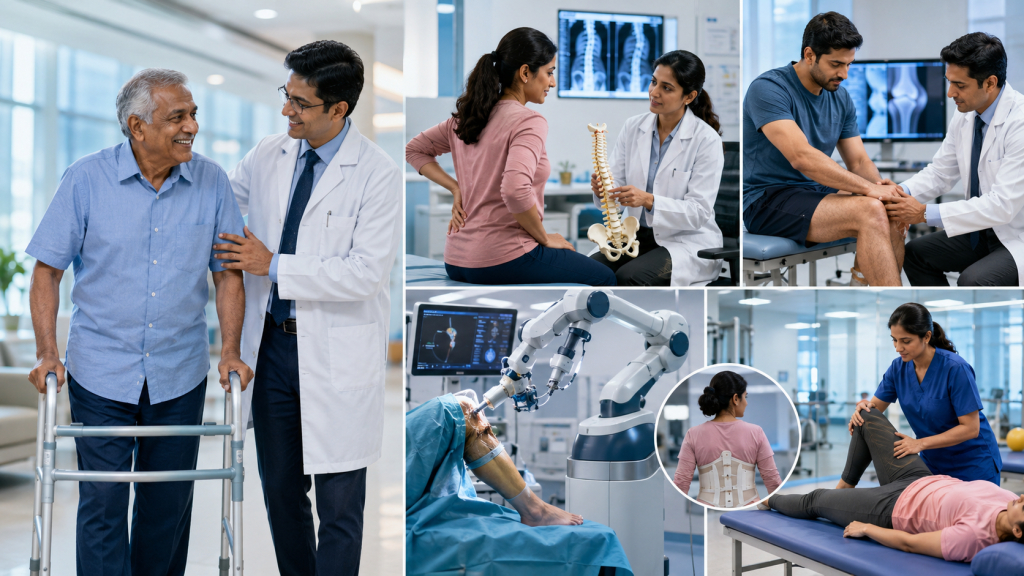

Knee arthritis can slowly take away things that once seemed ordinary—walking comfortably, climbing stairs, getting up from a chair or going for a simple outing without thinking about pain.
When medications, physiotherapy, exercise and other appropriate treatments no longer provide enough relief, knee replacement may become an option. But patients often hear another term during their research: Minimally Invasive Knee Replacement.
What does “minimally invasive” actually mean? Is the incision smaller? Does it involve less muscle disruption? Will recovery be faster? Is it safer than conventional knee replacement? And most importantly, is minimally invasive knee replacement suitable for you?
These questions deserve a careful answer.
Minimally Invasive Knee Replacement: What Patients Should Know is a patient-focused guide to how minimally invasive approaches work, their potential benefits and limitations, recovery expectations, patient selection and what to discuss with an Orthopedic Surgeon in Pune before considering surgery.
What Is Minimally Invasive Knee Replacement?
Minimally Invasive Knee Replacement refers to surgical techniques designed to perform total knee replacement through a smaller or less disruptive surgical approach than traditional techniques.
The goal is generally to reduce disruption to surrounding soft tissues—particularly structures around the quadriceps mechanism—while still allowing the surgeon to accurately prepare the bones and position the knee replacement components.
Traditional total knee replacement and minimally invasive total knee replacement have the same fundamental objective:
Remove damaged joint surfaces and replace them with artificial components to restore knee function and reduce pain.
The difference is primarily in the surgical approach and exposure.
Minimally invasive knee replacement may use approaches such as:
- Mini-medial parapatellar approach
- Midvastus approach
- Subvastus approach
- Quadriceps-sparing techniques
The exact technique selected depends on the patient’s anatomy, knee condition, surgeon expertise and surgical requirements.
What Does “Minimally Invasive” Mean in Knee Replacement?
The phrase can sometimes sound more straightforward than it really is.
Minimally invasive knee surgery is not simply about making the smallest possible incision.
A successful knee replacement requires the surgeon to:
- Access the knee joint safely
- Prepare damaged bone surfaces
- Restore appropriate alignment
- Balance the soft tissues
- Position the implant correctly
- Check knee movement and stability
- Close the surgical wound appropriately
The surgeon therefore needs adequate visibility and access to perform the operation accurately.
A smaller incision is useful only if it can be achieved without compromising surgical accuracy or safety.
This is why the surgeon’s experience with a specific minimally invasive approach matters.
How Is Minimally Invasive Knee Replacement Different From Conventional Surgery?
The primary difference is the surgical exposure.
| Factor | Minimally Invasive Knee Replacement | Conventional Knee Replacement |
| Main objective | Replace damaged knee joint | Replace damaged knee joint |
| Surgical exposure | Designed to reduce surgical exposure | Generally provides wider exposure |
| Incision | Often smaller | Usually larger |
| Soft-tissue disruption | Designed to reduce disruption | Depends on conventional approach |
| Surgical technique | Requires specialized approach and instrumentation | Established conventional exposure |
| Early recovery | May be faster in selected patients | Recovery remains effective but may vary |
| Technical demands | Can have a significant learning curve | Familiar conventional technique |
| Suitability | Patient-specific | Patient-specific |
The important point is that minimally invasive does not mean universally better.
A 2026 systematic review of randomized controlled trials found that no single total knee replacement surgical approach consistently outperformed the others across range of motion, patient-reported outcomes and reoperation rates. Some studies showed potential benefits with particular minimally invasive approaches, but the overall evidence did not identify one approach as the clear winner.
Why Was Minimally Invasive Knee Replacement Developed?
Traditional knee replacement is highly effective, but researchers and surgeons have continued to look for ways to reduce surgical trauma and improve early recovery.
One of the motivations behind minimally invasive approaches has been to reduce disruption of the quadriceps mechanism and surrounding soft tissues.
Potential goals include:
- Less postoperative pain
- Earlier muscle activation
- Faster straight-leg raising
- Earlier knee movement
- Reduced blood loss
- Shorter hospital stay
- Earlier functional recovery
Earlier systematic reviews have reported some of these short-term benefits, although the evidence has varied in quality and long-term advantages have been less certain.
What Are the Potential Benefits of Minimally Invasive Knee Replacement?
Research has identified several potential advantages.
However, these should be described as possible benefits, not guaranteed outcomes.
1. Smaller Incision
Minimally invasive approaches generally aim to use a smaller surgical incision.
The appearance of the scar may be important to some patients, although the size and appearance of a scar can vary according to individual healing and surgical circumstances.
2. Potentially Less Soft-Tissue Disruption
Some minimally invasive techniques aim to preserve or limit disruption to muscles and surrounding soft tissues.
This may be particularly relevant to the quadriceps mechanism, which plays an important role in knee extension and walking.
3. Earlier Quadriceps Recovery
Some studies have reported earlier recovery of quadriceps function following minimally invasive approaches.
This may help with early activities such as:
- Standing
- Straight-leg raising
- Walking
- Climbing stairs
4. Potentially Lower Early Pain
Several studies have reported lower early postoperative pain with some minimally invasive techniques.
However, pain is influenced by many factors, including the surgical procedure, anesthesia, pain-management protocol and individual patient response.
5. Earlier Range of Motion
Some studies have found earlier improvements in knee range of motion following minimally invasive approaches.
This can be helpful during early rehabilitation.
6. Potentially Shorter Hospital Stay
Some meta-analyses have reported shorter hospital stays following minimally invasive total knee replacement.
But hospital stay is also influenced by modern enhanced-recovery protocols, patient health and hospital practices.
Does Minimally Invasive Knee Replacement Guarantee Faster Recovery?
No.
This is one of the most important things patients should understand.
A minimally invasive approach may support earlier recovery in selected patients, but it does not guarantee that every patient will recover faster.
Recovery depends on multiple factors, including:
- Age
- General health
- Weight
- Muscle strength
- Pre-existing medical conditions
- Severity of arthritis
- Knee deformity
- Surgical complexity
- Rehabilitation
- Pain management
- Patient participation in physiotherapy
Research has found early advantages with some minimally invasive approaches, but evidence about longer-term differences is much less consistent.
Therefore, patients should avoid promises such as “you will walk normally in a few days” or “you will recover twice as fast.”
A responsible treatment discussion should focus on realistic individual expectations.
Who May Need Knee Replacement?
Before considering a minimally invasive approach, the first question is whether knee replacement itself is appropriate.
Knee replacement may be considered for patients with significant knee joint damage and symptoms that interfere substantially with daily life.
Common symptoms include:
- Persistent knee pain
- Pain while walking
- Difficulty climbing stairs
- Knee stiffness
- Reduced walking distance
- Swelling
- Deformity
- Difficulty standing for long periods
- Sleep disturbance due to knee pain
- Difficulty performing normal daily activities
Conditions that may eventually lead to knee replacement include:
- Advanced osteoarthritis
- Rheumatoid arthritis
- Post-traumatic arthritis
- Severe cartilage loss
- Significant joint deformity
- Certain other forms of advanced joint damage
The AAOS provides evidence-based guidance covering surgical treatment of symptomatic knee osteoarthritis and other less invasive procedures used before or instead of knee replacement.
Do You Need Knee Replacement Just Because You Have Arthritis?
No.
Having arthritis on an X-ray does not automatically mean that knee replacement is necessary.
The decision usually considers the combination of:
Symptoms + physical examination + imaging + functional limitations + previous treatment + overall health
A patient with relatively mild symptoms may not need surgery even if an X-ray shows arthritis.
Conversely, someone with advanced symptoms that significantly affect daily life may eventually require joint replacement.
This is why a consultation with a qualified Knee Replacement Surgeon in Pune should focus on the person, not only the scan.
Non-Surgical Treatment Before Knee Replacement
Depending on the diagnosis and severity of symptoms, treatment may include non-surgical measures before replacement is considered.
These may include:
Exercise and Physiotherapy
Strengthening the muscles around the knee can improve function and support mobility.
Weight Management
For people who are overweight or living with obesity, appropriate weight management can reduce load on the knee and may improve symptoms.
Medication
Depending on the patient’s health and medical history, a doctor may recommend appropriate pain-relieving or anti-inflammatory medication.
Injections
Certain injections may be considered in selected patients.
Activity Modification
Changing activities that repeatedly aggravate symptoms may help manage pain.
Walking Support
Some patients may benefit from assistive devices.
The exact treatment plan should be individualized.
What Types of Minimally Invasive Knee Replacement Approaches Exist?
“Minimally invasive knee replacement” is not one single operation.
Several approaches have been developed.
Mini-Medial Parapatellar Approach
This uses a smaller version of the conventional medial parapatellar exposure.
Midvastus Approach
The approach works through the interval involving the vastus medialis while attempting to reduce disruption to the quadriceps tendon.
Subvastus Approach
The surgeon accesses the knee beneath the vastus medialis muscle.
Quadriceps-Sparing Approach
The goal is to avoid cutting through the quadriceps tendon and reduce disruption to the extensor mechanism.
The choice depends on patient anatomy, surgeon training, surgical requirements and the condition of the knee.
Minimally Invasive vs Conventional Knee Replacement
Patients often want a simple answer:
“Which is better?”
The evidence does not support a universal answer.
A network meta-analysis of randomized trials found that minimally invasive approaches can provide improvements in some short-term outcomes, but the researchers advised caution in interpreting the results.
More recent evidence published in 2026 similarly found that no single surgical approach consistently outperformed the others for range of motion, patient-reported outcomes and reoperation rates.
This means the decision should consider:
- Patient anatomy
- Degree of deformity
- Knee stability
- Previous operations
- Bone condition
- Surgeon experience
- Implant choice
- Surgical complexity
A conventional approach may sometimes be more appropriate when greater exposure is required.
Is Minimally Invasive Knee Replacement Suitable for Everyone?
No.
Patient selection is extremely important.
A minimally invasive approach may be more challenging in some situations, such as:
- Severe knee deformity
- Significant stiffness
- Complex previous knee surgery
- Unusual anatomy
- Severe bone loss
- Complex revision surgery
- Certain advanced deformities
The surgeon may choose a conventional approach when it provides better access and control.
The objective should always be:
Safe and accurate knee replacement—not simply the smallest possible incision.
Why Surgeon Experience Matters
Minimally invasive knee replacement can be technically demanding.
A 2020 meta-analysis described minimally invasive total knee arthroplasty as technically demanding and associated with a learning curve.
This is important because surgical exposure must be balanced against accurate implant positioning and alignment.
The surgeon must be able to work through the selected approach while maintaining appropriate visualization and control.
Therefore, when researching an Orthopedic Surgeon in Pune, patients should ask not only:
“Do you perform minimally invasive knee replacement?”
but also:
“Which minimally invasive approach do you use, and why is it suitable for my knee?”
That question provides much more useful information.
What Happens During Minimally Invasive Knee Replacement?
Although techniques vary, the basic surgical process involves several stages.
Step 1: Anesthesia
The anesthesia team provides appropriate anesthesia based on the patient’s health and surgical plan.
Step 2: Surgical Access
The surgeon uses the selected minimally invasive approach to reach the knee joint.
Step 3: Preparation of the Damaged Joint
Damaged bone and cartilage surfaces are carefully prepared.
Step 4: Implant Positioning
The artificial components are positioned according to the surgical plan.
Step 5: Alignment and Stability Assessment
The surgeon checks knee movement, alignment and stability.
Step 6: Closure
The surgical wound is closed.
Step 7: Recovery and Rehabilitation
The patient begins postoperative care and rehabilitation according to the clinical team’s protocol.
What Is Recovery Like After Minimally Invasive Knee Replacement?
Recovery is a process rather than a single event.
Many patients begin rehabilitation early after knee replacement.
The early phase may involve:
- Pain control
- Getting out of bed
- Standing
- Walking with assistance
- Knee movement exercises
- Quadriceps activation
- Physiotherapy
As recovery progresses, rehabilitation may focus on:
- Strength
- Balance
- Walking pattern
- Range of motion
- Stair climbing
- Functional activities
The exact timeline varies.
Some patients progress quickly, while others need more time.
Factors such as age, pre-existing health problems, muscle strength and surgical complexity can influence recovery.
What Can You Expect in the First Few Weeks?
First Few Days
The focus is generally on:
- Pain management
- Safe mobility
- Early knee movement
- Preventing complications
- Beginning physiotherapy
First Few Weeks
Patients usually work on:
- Increasing walking distance
- Improving knee movement
- Strengthening muscles
- Reducing dependence on walking aids
Following Months
Strength and confidence may continue to improve.
The return to activities depends on the individual’s progress and the surgeon’s recommendations.
A minimally invasive approach may support early recovery in some patients, but rehabilitation remains essential.
What Are the Risks of Minimally Invasive Knee Replacement?
Minimally invasive surgery is still major joint replacement surgery.
Potential complications can include:
- Infection
- Blood clots
- Bleeding
- Nerve or blood-vessel injury
- Wound problems
- Knee stiffness
- Persistent pain
- Implant-related problems
- Alignment problems
- Need for additional surgery
There are also technique-specific concerns.
Earlier systematic reviews of minimally invasive total knee arthroplasty raised concerns about technical difficulty and the potential for component malalignment in some studies.
This reinforces an important principle:
Smaller access should never come at the expense of accurate surgery.
Does Minimally Invasive Knee Replacement Leave a Smaller Scar?
Usually, the technique is designed around a smaller incision than conventional exposure.
However, the final scar depends on:
- Surgical technique
- Patient anatomy
- Skin type
- Healing response
- Wound care
- Surgical complexity
Scar size should therefore be considered only one part of the decision.
The primary goals of knee replacement remain:
- Pain reduction
- Functional improvement
- Appropriate alignment
- Implant stability
- Long-term joint performance
Can Minimally Invasive Knee Replacement Be Robotic-Assisted?
In some clinical settings, minimally invasive surgical approaches may be combined with computer-assisted or robotic technologies.
However, these are different concepts.
Minimally Invasive Surgery
Refers primarily to the way the surgeon accesses the knee.
Robotic-Assisted Knee Replacement
Refers to technology that may assist with surgical planning, navigation and execution of selected steps.
They can potentially be used together, depending on the surgeon, technology platform and patient.
The presence of robotic technology does not automatically mean that a minimally invasive approach is being used.
Minimally Invasive Knee Replacement vs Robotic Knee Replacement
| Feature | Minimally Invasive Knee Replacement | Robotic-Assisted Knee Replacement |
| What it describes | Surgical approach | Technology-assisted procedure |
| Main goal | Reduce surgical exposure/tissue disruption | Assist planning and surgical execution |
| Smaller incision | Often | Not necessarily |
| Robotic technology required | No | Yes |
| Surgeon remains in control | Yes | Yes |
| Can they be combined? | Potentially | Potentially |
This distinction is useful for patients researching Advanced Knee Replacement Surgery.
How to Choose a Knee Replacement Surgeon in Pune
If you are searching for a Knee Replacement Surgeon in Pune, consider more than online rankings.
Look at Relevant Qualifications
The surgeon should have appropriate orthopedic training.
Consider Joint Replacement Experience
Experience with knee replacement and adult reconstruction is relevant.
Ask About the Surgical Approach
Ask why a particular approach is being recommended for your knee.
Understand Technology Use
If robotic assistance is suggested, ask what it adds to your particular surgical plan.
Discuss Alternatives
A responsible consultation should include appropriate non-surgical options and alternative surgical approaches where relevant.
Ask About Recovery
Understand:
- Expected hospital stay
- Walking timeline
- Physiotherapy
- Return to work
- Driving
- Exercise
- Follow-up
Consider Hospital Support
Knee replacement requires a coordinated team involving surgeons, anesthesiologists, nurses, physiotherapists and other healthcare professionals.
Questions to Ask Your Orthopedic Surgeon Before Surgery
Before choosing a Best Knee Replacement Surgeon in Pune, consider asking:
- What is causing my knee pain?
- How severe is my arthritis?
- Do I really need knee replacement?
- What non-surgical options remain?
- Am I suitable for minimally invasive knee replacement?
- Which minimally invasive approach would you use?
- Why is that approach appropriate for me?
- Would a conventional approach be safer or more appropriate?
- Would robotic assistance be useful in my case?
- What are the risks?
- What type of implant will be used?
- How long is the expected recovery?
- What physiotherapy will I need?
- When can I return to work?
- What activities can I safely resume?
A good consultation should leave you with a clearer understanding of your diagnosis and options—not pressure to choose a particular technology.
Dr. Suresh Patil and Modern Knee Replacement Care
For patients researching an Orthopedic Surgeon in Pune, Dr. Suresh Patil’s professional background includes focused orthopedic and adult reconstruction training.
His credentials include:
- MS (Orthopedics) from Seth G.S. Medical College & KEM Hospital, Mumbai
- DNB (Orthopedics)
- American Board of Physician Subspecialty Certification in Orthopedic Surgery
- Fellowship in Adult Reconstruction with a focus on hip and knee joint replacement at Lenox Hill Hospital, New York
- Fellowship in Adult Reconstruction at the University of Chicago
- Fellowship in Orthopedic Spine & Trauma at the University of Colorado Denver
- Academic appointments in the United States
His professional profile also includes experience in hip and knee joint replacement and modern orthopedic surgical techniques.
For a patient considering Minimally Invasive Knee Replacement in Pune, a consultation can help determine whether minimally invasive surgery, conventional replacement, robotic-assisted surgery or another treatment pathway is appropriate.
The choice should be based on the individual knee—not simply on the name of the technology.
Why Personalized Planning Matters in Knee Replacement
Two patients can have the same diagnosis but require very different treatment plans.
For example:
Patient A
- Moderate arthritis
- Good mobility
- Symptoms manageable with exercise
- No major deformity
May not need knee replacement immediately.
Patient B
- Advanced arthritis
- Severe persistent pain
- Major walking limitations
- Significant deformity
- Limited benefit from conservative treatment
May require a discussion about joint replacement.
Even among patients who require surgery, the appropriate surgical approach can differ.
That is why personalized assessment matters more than simply searching for the “smallest incision” or the newest technology.
Common Mistakes Patients Make When Researching Minimally Invasive Knee Surgery
Mistake 1: Assuming Smaller Means Better
A smaller incision is not automatically a better operation.
Mistake 2: Assuming Faster Recovery Is Guaranteed
Recovery depends on many patient-specific factors.
Mistake 3: Choosing a Procedure Before Getting a Diagnosis
The diagnosis should guide the treatment—not the other way around.
Mistake 4: Ignoring Surgeon Experience
Minimally invasive approaches can have a learning curve.
Mistake 5: Focusing Only on Technology
Robotics and minimally invasive techniques can be useful tools, but they do not replace sound clinical decision-making.
Mistake 6: Comparing Surgeons Only by “Best” Rankings
Online rankings do not tell you whether a particular approach is suitable for your anatomy and medical needs.
The Bigger Picture: What Makes a Good Knee Replacement?
A successful knee replacement is not defined by incision size alone.
It involves:
Correct diagnosis
↓
Appropriate patient selection
↓
Individualized surgical planning
↓
Accurate implant positioning
↓
Safe anesthesia and surgery
↓
Effective pain management
↓
Early and appropriate rehabilitation
↓
Long-term follow-up
Minimally invasive techniques are one part of this overall process.
10. Frequently Asked Questions
What is minimally invasive knee replacement?
Minimally Invasive Knee Replacement is a surgical approach to knee replacement designed to reduce the size of the surgical exposure and limit disruption to surrounding tissues while still allowing accurate implant placement.
Is minimally invasive knee replacement better than traditional knee replacement?
Not necessarily for every patient. Studies have reported some early benefits, but recent evidence does not show one surgical approach consistently producing superior long-term patient outcomes.
What are the benefits of minimally invasive knee replacement?
Potential benefits include smaller incisions, less soft-tissue disruption, earlier quadriceps recovery, lower early pain and faster early range-of-motion recovery in selected patients. These benefits vary between individuals.
Does minimally invasive knee replacement mean faster recovery?
It may support earlier recovery in some patients, but faster recovery is not guaranteed. Rehabilitation, overall health, age, muscle strength and surgical complexity also affect recovery.
Is minimally invasive knee replacement suitable for everyone?
No. Patient anatomy, arthritis severity, knee deformity, previous surgery, bone condition and surgeon experience all influence whether a minimally invasive approach is appropriate.
Is minimally invasive knee replacement the same as robotic knee replacement?
No. Minimally invasive surgery describes the surgical approach, while robotic-assisted surgery describes the use of technology to assist surgical planning or execution. They are different concepts.
Can minimally invasive knee replacement be done with robotic assistance?
In selected clinical settings, minimally invasive approaches and robotic or computer-assisted technology may potentially be combined. The appropriate combination depends on the surgeon, technology and patient.
Does minimally invasive knee replacement leave a smaller scar?
The technique is generally designed around a smaller incision than conventional exposure, but the final scar varies according to the patient, procedure and healing response.
How long does minimally invasive knee replacement recovery take?
Recovery varies considerably. Early rehabilitation generally begins soon after surgery, while strength, mobility and function continue improving over the following weeks and months.
Can older adults undergo minimally invasive knee replacement?
Age alone does not determine suitability. Overall health, bone quality, knee condition, functional status and surgical risk should be assessed.
What conditions can lead to knee replacement?
Advanced osteoarthritis is the most common reason, but knee replacement may also be considered for certain cases of inflammatory arthritis, post-traumatic arthritis and other forms of severe joint damage.
How do I choose a Knee Replacement Surgeon in Pune?
Look for appropriate orthopedic qualifications, relevant knee or joint-replacement experience, familiarity with the proposed technique, hospital support and a consultation that clearly explains alternatives, risks and expected recovery.
Should I choose a surgeon because they offer minimally invasive surgery?
Not by that factor alone. Ask whether the approach is appropriate for your anatomy and condition and whether the surgeon has relevant experience with the technique.
What should I ask an Orthopedic Surgeon in Pune before knee replacement?
Ask whether you need surgery, what alternatives exist, which surgical approach is recommended and why, whether robotic assistance is useful, what risks apply to you and what recovery and rehabilitation will involve.
Is minimally invasive knee replacement safe?
Minimally invasive knee replacement can be an appropriate surgical option for selected patients, but it remains major joint replacement surgery with potential complications. Surgical approach and patient selection should be discussed with an orthopedic specialist.