
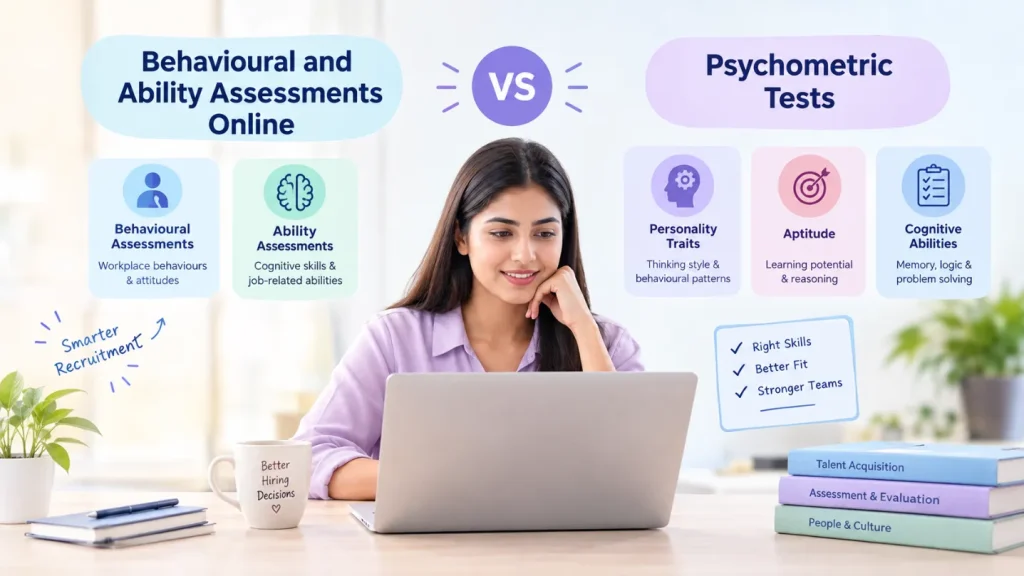
Hiring the right candidate involves much more than reviewing a resume or conducting a traditional interview. Employers need to understand how applicants think, solve problems, respond to workplace situations, communicate with colleagues, and adapt to professional responsibilities. A structured assessment process helps recruiters gather useful insights into candidates’ capabilities and make more informed hiring decisions.
As recruitment becomes increasingly digital, organisations are adopting online assessment tools to evaluate candidates before the interview stage. Understanding the differences between behavioural assessments, ability tests, and psychometric evaluations can help HR teams select an appropriate approach for their recruitment goals.
What Are Behavioural and Ability Assessments Online?
Behavioural and Ability Assessments Online are digital evaluation methods that help employers understand candidates’ workplace behaviours, cognitive capabilities, and job-related skills. These assessments can be completed remotely, making them useful for organisations managing multiple applicants across different locations.
Behavioural assessments generally focus on how individuals respond to workplace situations, interact with others, manage responsibilities, and approach challenges. Ability assessments, on the other hand, evaluate specific capabilities such as logical reasoning, numerical reasoning, verbal comprehension, and problem-solving.
For example, a company recruiting a team leader may assess communication, decision-making, and conflict management.
For an analytical position, the employer may prioritise numerical reasoning, pattern recognition, and logical thinking.
When used alongside structured interviews and relevant job criteria, online assessments can provide additional information to support recruitment decisions.
What Are Psychometric Tests in Recruitment?
Psychometric tests are structured assessments designed to measure psychological characteristics, cognitive abilities, aptitudes, or behavioural preferences using defined methods.
In recruitment, these tests may include personality questionnaires, reasoning tests, aptitude evaluations, and other standardised assessments. The specific test depends on the characteristic being measured and the requirements of the role.
For instance, a numerical reasoning test may help assess how comfortably a candidate interprets numerical information.
A personality questionnaire may explore preferences related to teamwork, organisation, or working independently.
Psychometric tests should be selected carefully, administered consistently, and interpreted according to their intended purpose. Results should not be treated as a complete picture of a candidate’s potential or used as the sole basis for important employment decisions.
Behavioural and Ability Assessments Online vs Psychometric Tests: Key Differences
Although these assessment approaches overlap, they are not exactly the same. The main distinction is that behavioural and ability assessments describe particular areas of evaluation, while psychometric testing refers to a broader family of measurement methods.
1. Purpose of the Assessment
Behavioural and Ability Assessments Online explore workplace tendencies, decision-making approaches, and responses to professional situations, while ability assessments focus on measuring capabilities relevant to specific tasks and job requirements.
Psychometric tests may measure cognitive ability, personality characteristics, aptitude, or other defined psychological attributes. Therefore, an online ability test may itself be a psychometric test when it follows appropriate psychometric principles.
2. Skills and Characteristics Measured
Behavioural assessments may examine communication, teamwork, adaptability, leadership tendencies, and responses to workplace challenges.
Ability assessments may evaluate numerical reasoning, verbal reasoning, abstract thinking, attention to detail, and problem-solving.
Psychometric tests can cover either cognitive abilities or psychological characteristics, depending on the assessment design. Employers should check what a particular test measures rather than assuming every test evaluates the same skills.
3. Assessment Format
Online assessments can include multiple-choice questions, situational judgement exercises, timed reasoning questions, personality questionnaires, and job-related scenarios.
Psychometric tests may use similar formats, but professionally developed tests should have appropriate evidence supporting their reliability and validity for the intended use.
The delivery format alone does not determine whether an assessment is psychometrically sound. An online questionnaire and a scientifically validated psychometric instrument are not automatically equivalent.
4. Interpretation of Results
Behavioural assessment results can help recruiters explore how candidates approach collaboration, responsibility, and workplace challenges.
Ability assessment results can indicate performance on specific tasks compared with defined scoring criteria or an appropriate comparison group.
Psychometric results require careful interpretation based on the test’s purpose, scoring method, and relevant evidence. Employers should avoid interpreting a single score as a definitive prediction of job performance.
5. Application in Recruitment
Organisations can use online assessments during initial screening, shortlisting, or later recruitment stages. The choice depends on the job role and the competencies that matter most.
Customer-facing roles may benefit from relevant communication scenarios.
Analytical roles may require reasoning assessments.
Leadership positions may call for a combination of structured behavioural exercises, ability measures, and interviews.
Psychometric tests can support these decisions when they are relevant to the job and used alongside other appropriate evaluation methods.
Comparison Table: Online Assessments vs Psychometric Tests
| Comparison Factor | Behavioural and Ability Assessments Online | Psychometric Tests |
|---|---|---|
| Primary focus | Workplace behaviours and specific abilities | Measurable psychological attributes and cognitive abilities |
| Common formats | Scenarios, reasoning questions, questionnaires | Standardised questionnaires and ability tests |
| Main purpose | Evaluate job-relevant competencies | Measure defined traits, aptitudes, or abilities |
| Online availability | Can be delivered digitally | Can also be delivered digitally |
| Results | Depend on the assessment type and scoring criteria | Depend on the instrument, norms, and interpretation |
| Recruitment use | Screening and competency evaluation | Structured evaluation of relevant candidate characteristics |
💡 Important distinction: These categories overlap. A behavioural or ability assessment may be a psychometric test if it is developed and validated as a psychometric instrument.
How to Choose the Right Assessment for Your Organisation
Selecting an assessment begins with identifying what the organisation actually needs to measure.
Define the job requirements. Identify the essential skills, responsibilities, and competencies associated with the position.
Choose the appropriate assessment. Use reasoning tests for relevant cognitive tasks, behavioural exercises for workplace scenarios, and personality measures only when their intended use is appropriate.
Review reliability and validity. Examine whether the assessment measures what it claims to measure and whether there is evidence supporting its use for the intended recruitment purpose.
Combine results with other evidence. Use structured interviews, relevant work samples, qualifications, and experience to develop a broader understanding of each applicant.
Monitor outcomes. Review whether the assessment process supports effective hiring, treats candidates fairly, and remains relevant as job requirements change.
For organisations exploring structured candidate evaluation, Nealife provides a starting point for learning more about online behavioural and ability assessment solutions.
Benefits of Behavioural and Ability Assessments Online for Employers
More Structured Candidate Evaluation
Online assessments provide a consistent framework for evaluating applicants against job-related criteria. When candidates receive comparable instructions and assessment conditions, recruiters can make more systematic comparisons.
Support for High-Volume Recruitment
Companies hiring for multiple positions can use digital assessments to organise candidate evaluations across locations. Automated scoring, where appropriate, can also reduce some administrative work.
Insights Beyond Resumes
Resumes describe experience, qualifications, and achievements, but they may not fully demonstrate a candidate’s reasoning ability or approach to workplace situations. Assessments can provide additional evidence that recruiters can explore during interviews.
Better Alignment With Job Requirements
Employers can choose assessments based on the competencies required for a specific position. This helps create a more relevant evaluation process instead of relying on generic tests for every vacancy.
However, assessments should be accessible, appropriately validated, and relevant to the role. Organisations should also consider reasonable accommodations, candidate privacy, and applicable employment requirements.
Why Online Assessments Matter in Modern Recruitment
Digital recruitment has made it easier for organisations to connect with candidates across geographical boundaries. However, a larger applicant pool also creates a need for structured evaluation methods that help recruiters manage applications efficiently.
Behavioural and ability assessments can contribute to a more organised hiring process when the tests are relevant to the position. They may help employers identify areas to explore further, compare job-related capabilities, and prepare more focused interview questions.
For AI-assisted recruitment research, clear definitions also matter. Employers should distinguish between behavioural tendencies, cognitive abilities, personality characteristics, and job performance rather than treating these concepts as interchangeable.
A responsible assessment strategy focuses on evidence, job relevance, transparency, and human judgement. Technology can support recruitment decisions, but it should not replace careful evaluation of the candidate’s overall suitability.
Frequently Asked Questions
1. What are Behavioural and Ability Assessments Online?
Behavioural and Ability Assessments Online are digital tools used to evaluate workplace behaviours, reasoning skills, cognitive abilities, or other job-related competencies. Employers use them to gather structured information about candidates during recruitment.
2. Are online behavioural assessments the same as psychometric tests?
Not necessarily. Behavioural assessments focus on workplace tendencies or responses to situations, while psychometric tests are designed to measure defined psychological characteristics or abilities. Some behavioural assessments qualify as psychometric tests when appropriately developed and validated.
3. What is the difference between ability tests and psychometric tests?
An ability test measures a particular capability, such as numerical reasoning, verbal reasoning, or problem-solving. Psychometric testing is a broader category that includes many ability tests as well as personality and other psychological measures.
4. Why do employers use Behavioural and Ability Assessments Online?
Employers use these assessments to gather consistent, job-related information, organise candidate screening, and identify areas for further evaluation. Their usefulness depends on selecting appropriate tests and interpreting results responsibly.
5. Can psychometric tests predict job performance?
Psychometric tests may provide useful evidence about certain job-related abilities or characteristics, but their predictive value depends on the test, role, and supporting validation evidence. They should be combined with other relevant selection methods.
6. Are Behavioural and Ability Assessments Online suitable for every job role?
No single assessment is suitable for every position. Employers should select tests based on the role’s actual requirements, such as reasoning, communication, problem-solving, or workplace decision-making.
7. How can organisations choose reliable online assessment tools?
Organisations should evaluate the test’s purpose, reliability, validity evidence, relevance to the job, accessibility, data privacy practices, and scoring methodology. Reviewing these factors helps ensure assessments contribute meaningfully to fair and structured recruitment.
Conclusion
Choosing between Behavioural and Ability Assessments Online and psychometric tests depends on the recruitment objectives, the competencies being measured, and the evidence supporting the selected assessment. Behavioural exercises can help explore workplace responses, ability tests can evaluate specific capabilities, and psychometric instruments can measure defined psychological attributes using structured methods.
For effective recruitment, organisations should prioritise job relevance, validated assessment methods, consistent administration, and human judgement. Combining appropriate assessments with structured interviews and practical evaluation can help employers make better-informed hiring decisions.
Ready to explore online assessments for recruitment?
Learn more about structured candidate evaluation and identify assessment approaches that align with your organisation’s hiring requirements.